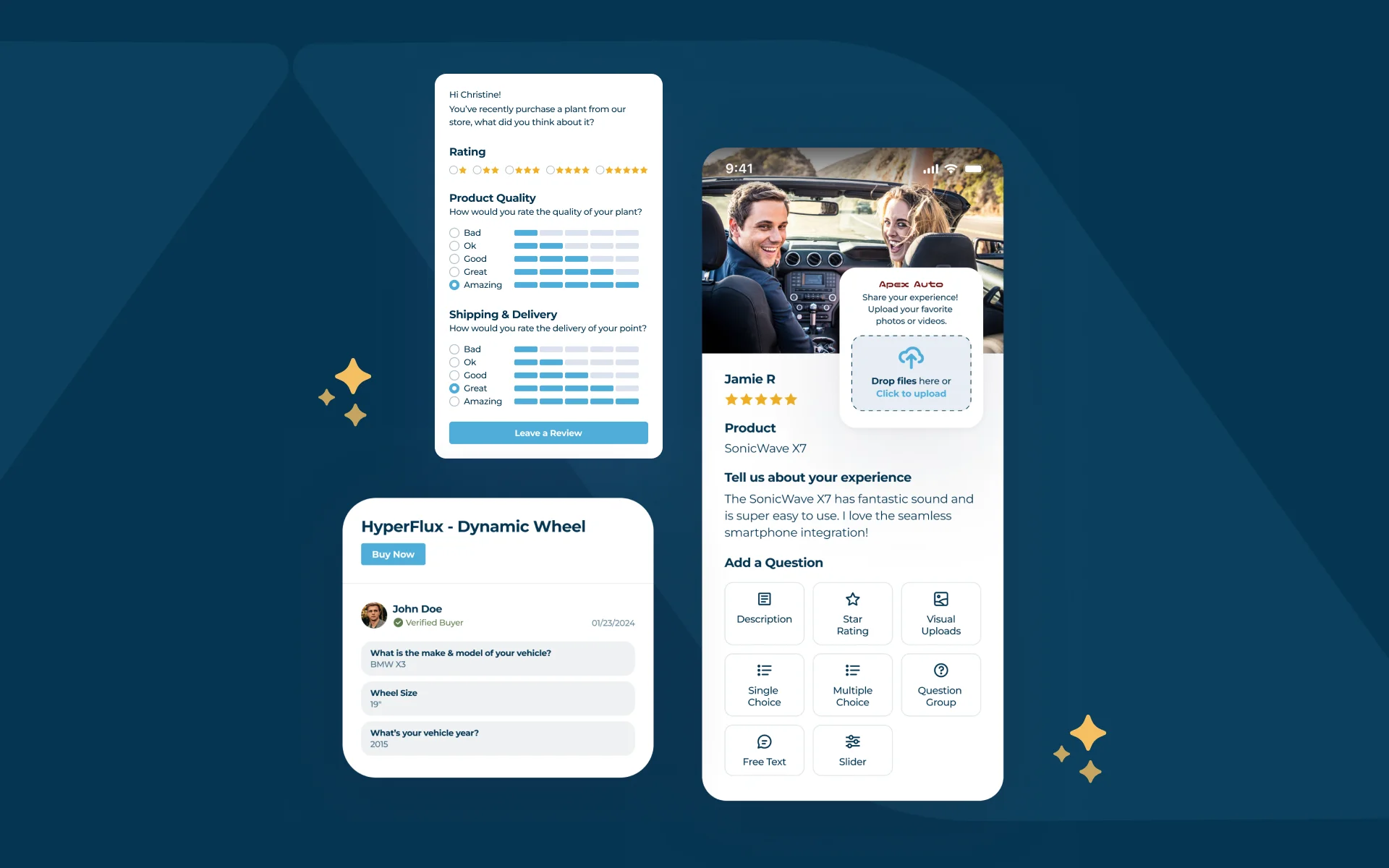
A subscriber does not usually cancel out of nowhere. They get a damaged first box, or the second shipment shows up two weeks late, or the product just is not clicking, and they go quiet. Then the renewal charge hits, they remember they meant to cancel, and they do. By the time you see the cancellation, the decision was made weeks ago.
This is the part most subscription brands miss: the unhappiness shows up in a survey response or a lukewarm review long before it shows up in your churn report. That gap is your opening. This guide is for subscription and DTC operators, CX leads, and founders who want to use reviews and experience surveys as an early-warning system. Used this way, reviews reduce subscription churn instead of just decorating product pages.
Why subscription churn is a feedback problem, not just a billing one
When churn climbs, the first instinct is to look at billing. Tighten the dunning emails, retry failed cards, add a pause option. That work matters, but it only addresses part of the problem.
Involuntary churn, the kind caused by failed or expired payments, is roughly 30 to 40 percent of total churn at most subscription brands (enComm). The majority is voluntary. Those subscribers made a decision to leave. Dunning logic cannot recover someone who actively wants out, but a conversation often can.
Voluntary churn is a feedback problem. People leave because the product, the cadence, or the experience stopped being worth the recurring charge. The only way to catch that early is to ask, and the only way asking helps is if you do something with the answer.
The stakes are not subtle. A 5 percent increase in retention can lift profits by 25 to 95 percent (Bain & Company). For a subscription business, where the whole model depends on a customer staying past the point where you recover acquisition cost, a few saved subscribers per cohort compounds fast.
The early-warning signal hiding in your reviews and surveys
Emotional signals come before behavioral ones. A subscriber who answers a mid-cycle survey with a 3 out of 10 has not cancelled yet, but they are telling you they are going to. Per Zendesk, 82 percent of customers who churn had at least one negative support interaction in the 90 days before they left (via Recurringo). The dissatisfaction is observable. Most brands just are not looking at it as a churn signal.
This is what makes reviews and experience surveys different from a churn-prediction model. A model infers risk from behavior after the fact. A survey response is the subscriber telling you directly, in their own words, while there is still a subscription to save.
NPS is a flag, not a gospel metric
A quick caution. NPS is useful as a trigger, not as a scoreboard. Chasing the number leads to gaming it. The value is operational: a detractor score is a task, not a data point. Pair the score with behavioral signals like a drop in logins, skipped shipments, or an open support ticket, and you get a sharper read than any single metric gives you.
Mapping surveys to the subscription lifecycle
Here is the core of it. The same survey sent at the wrong time is noise. Sent at the right moment in the subscription lifecycle, it becomes the cheapest churn signal you have. There are four moments that matter.
Post-first-delivery. The first box sets the tone for the whole relationship, and the early window is where you bleed the most subscribers. Studies of subscription cohorts put first-90-day cancellations near 44 percent, with a large share of first-order subscribers gone by month three (Eightx). Send a short experience survey 3 to 5 days after the first delivery lands. You are not asking for a review yet. You are checking that the unboxing, the product, and the expectation all matched.
Mid-cycle. Halfway between deliveries, send a one-question engagement pulse. Are they using what they got? A subscriber who stopped using the product is a renewal you are about to lose, even if nothing went wrong. This is the quietest churn, and a single question catches it.
Pre-renewal. This is the highest-leverage moment in the entire lifecycle. Send a pulse 7 to 10 days before the renewal charge. A subscriber is far more honest when the decision is in front of them, and a low score here is a live save opportunity, not a postmortem. Catch a detractor at this point and you can still change the outcome.
Post-cancel. When someone does cancel, ask one question: why. The exit reason is the most actionable feedback you will ever collect, because it tells you which of the earlier checkpoints failed. Read the answers as a map back to a moment you missed:
- "Too much product piling up" points at a missing mid-cycle pulse. You should have caught the unused boxes.
- "It got too expensive" points at a pre-renewal touch that never fired, or fired without an offer.
- "The product was not what I expected" points at a post-delivery survey you either skipped or ignored.
Patterns in cancel reasons should rewrite your earlier surveys. If three in ten exits say "too much product," your mid-cycle question is in the wrong place or missing entirely.
A platform built for this, like RaveCapture, lets you tie each of these surveys to the billing event rather than the order date, so the pre-renewal pulse actually fires before the charge instead of after.
Routing detractors to support before they cancel
Collecting the signal is half the job. The other half is acting on it within hours, not at the end of a reporting cycle.
Set up a simple rule: any survey score below your threshold (a 6 or lower on a 10-point scale is a reasonable line) routes straight to a human with a short SLA. Not a queue someone reviews weekly. A flagged task someone owns today. The whole point of catching the signal early is wasted if it sits unread for a week and the renewal charge fires first.
The tone of the outreach matters too. You are not defending the product. You are asking what went wrong and offering to fix it. A replacement box, a cadence change, a pause instead of a cancel, a quick how-to for a product they are using wrong. Most detractors are not lost. They are frustrated and waiting to see if you care.
Keep the first message short and human. Something like: "Saw your last note and that is on us. Want me to send a replacement and stretch your next shipment out by two weeks?" One acknowledgment, one specific offer, one question. Skip the apology paragraph and the survey-link follow-up. A detractor who is already halfway out will not read a wall of text.
Recommend, do not dictate. If a subscriber is getting too much product, suggest a longer interval before you suggest they leave entirely. If they cannot use what they have, offer a swap before a refund. Give them the path that keeps them, and make the alternative their choice. The brands that win here treat a cancel request as the start of a conversation, not the end of one.
Closing the loop, and why it retains
The survey does not retain anyone. Closing the loop does.
Closing the loop means three things: you resolved the specific issue, you followed up to confirm it is fixed, and you marked the subscriber as recovered so you can measure it later. A detractor who gets a fast, genuine fix often becomes more loyal than a subscriber who never had a problem, because now they have seen what happens when something goes wrong.
Skip the follow-up and the whole exercise collapses into a feedback-collection vanity project. The subscriber told you they were unhappy, you logged it, and nothing changed. That is worse than not asking, because now they know you ignored them.
Measuring the churn delta
If you cannot measure it, you cannot defend the time it takes. Three numbers tell you whether the loop is working.
- Renewal rate, responders versus non-responders. Cohort the subscribers who engaged with your surveys against those who did not. If responders renew at a higher rate, the act of asking (and acting) is paying off.
- Detractor-recovery rate. Of the detractors you flagged and routed, how many renewed instead of cancelling? This is the most direct measure of the loop's impact.
- Cohort churn delta. Track churn for a cohort over consecutive billing cycles, before and after you turn the loop on. You are looking for the voluntary-churn slice to shrink while involuntary churn stays flat.
Make it concrete. Say a cohort of 1,000 subscribers churns at 6 percent a month, so you lose 60. If 200 of them are detractors you flagged and you recover even a quarter of those before renewal, that is 50 saved subscribers. On a 40 dollar monthly plan, those 50 are 24,000 dollars in retained annual revenue from one loop, before you count the second-order effect of a recovered subscriber who now trusts you more.
Watch the trend across cycles, not a single month. Subscription churn is noisy month to month, and one good or bad cohort can mislead you. Give the loop two or three full billing cycles before you judge it.
Common mistakes (and the do / don't lines)
A few patterns sink this before it starts.
- Do: tie survey timing to the billing cycle. Don't: blast everyone on the same calendar date regardless of where they are in their subscription.
- Do: survey after the first delivery. Don't: survey at signup, before the subscriber has experienced anything worth rating.
- Do: route low scores to a human within hours. Don't: let detractor responses pile up in a dashboard nobody opens.
- Do: ask one strong question per touch. Don't: stack five questions on a subscriber who is already half out the door.
- Do: close the loop and follow up. Don't: collect feedback you never act on, which trains subscribers that telling you is pointless.
The thread through all of these is the same. The survey is only as good as what you do in the next 48 hours. For more on getting the timing and question design right, see our guide on optimizing post-purchase surveys.
Where to start
If you only do one thing after reading this, add a pre-renewal survey 7 to 10 days before the charge and route every low score to a real person the same day. It is the one moment in the lifecycle where a low score is still a save instead of a goodbye, and most brands have nothing running there.
Get that one loop working end to end (survey, route, resolve, follow up, measure), then layer in the post-delivery and mid-cycle checkpoints. The brands that keep subscribers are not the ones with the best dunning logic. They are the ones who hear the quiet "this is not working for me" and answer it before the renewal date does it for them.